
 Come enjoy some delicious Chicharrones and support the S.O.L. Club on June 9 in the Tollefson Plaza from 12-3 p.m. Come enjoy some delicious Chicharrones and support the S.O.L. Club on June 9 in the Tollefson Plaza from 12-3 p.m.
Updated:
6/8/2026 5:51:08 PM
|
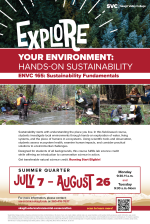 Explore the PNW while earning college credit this summer! SVC's new Environmental Conservation course combines indoor field experience with hands-on learning! Explore the PNW while earning college credit this summer! SVC's new Environmental Conservation course combines indoor field experience with hands-on learning!
Updated:
5/26/2026 3:03:22 PM
|
 Bring your donations to PTK's Annual Rummage Sale! Drop off on May 29 in the Cardinal Center Cafeteria from 4-7 PM Bring your donations to PTK's Annual Rummage Sale! Drop off on May 29 in the Cardinal Center Cafeteria from 4-7 PM
Updated:
5/26/2026 2:25:12 PM
|
 Come by the Cardinal Center Cafeteria on May 30 for a Spring Rummage Sale! Come by the Cardinal Center Cafeteria on May 30 for a Spring Rummage Sale!
Updated:
5/26/2026 2:23:09 PM
|
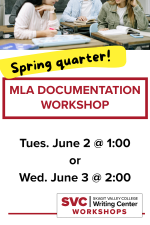 Swing by to get help with the tricky parts of MLA Documentation. Come get your questions answered in the Writing Center, L-321. Swing by to get help with the tricky parts of MLA Documentation. Come get your questions answered in the Writing Center, L-321.
Updated:
5/11/2026 1:28:30 PM
|
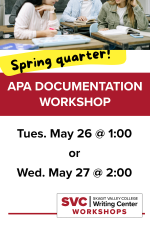 Stop by for the basics, the tricky bits, and answers to your questions. SVC Writing Center, L-321 Stop by for the basics, the tricky bits, and answers to your questions. SVC Writing Center, L-321
Updated:
5/11/2026 1:25:46 PM
|
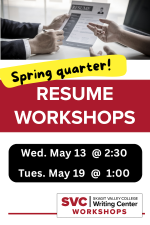 Looking for work? The Writing Center can help you write your best resume! Learn about what to put on your resume and how to format it. Attend one of two workshop times! Looking for work? The Writing Center can help you write your best resume! Learn about what to put on your resume and how to format it. Attend one of two workshop times!
Updated:
5/11/2026 1:21:43 PM
|
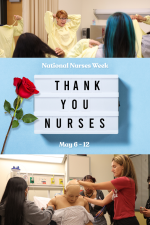 Thank you, nurses! #NationalNursesWeek Thank you, nurses! #NationalNursesWeek
Updated:
5/4/2026 12:45:30 PM
|
 Come find your next garden additions this May 5 from 9 a.m. - 2 p.m. in the Knutzen Cardinal Center! Come find your next garden additions this May 5 from 9 a.m. - 2 p.m. in the Knutzen Cardinal Center!
Updated:
4/28/2026 1:33:01 PM
|
.thumb.png) Join us at the upcoming Lead & Serve Expo to connect with community partners, explore leadership opportunities, and find meaningful ways to connect. Join us at the upcoming Lead & Serve Expo to connect with community partners, explore leadership opportunities, and find meaningful ways to connect.
Updated:
4/23/2026 3:14:45 PM
|
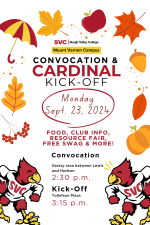 We're looking for the next Cardinal Mascot! Interested? Scan the QR to fill out the interest form by May 8 to be considered. We're looking for the next Cardinal Mascot! Interested? Scan the QR to fill out the interest form by May 8 to be considered.
Updated:
4/22/2026 10:33:54 AM
|
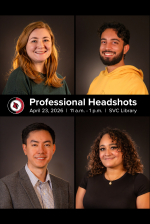 Come get a professional headshot for your resume or LinkedIn! Come to the Creation Center in the SVC Library on Thursday, April 23. Wear a nice shirt! Must be an SVC Student. Come get a professional headshot for your resume or LinkedIn! Come to the Creation Center in the SVC Library on Thursday, April 23. Wear a nice shirt! Must be an SVC Student.
Updated:
4/14/2026 9:40:35 AM
|
 SVC's Annual Car Show is back! Enter your car, or come admire them on June 6! Visit skagit.edu/car-show for more SVC's Annual Car Show is back! Enter your car, or come admire them on June 6! Visit skagit.edu/car-show for more
Updated:
4/10/2026 8:16:52 AM
|
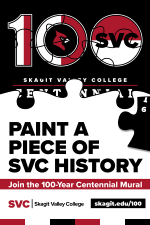 Leave your mark on SVC History by painting your piece to the puzzle. WIC: Oak Hall Coffee Shop April 8, 11-3 p.m. Mount Vernon: Cardinal Center April 9, 11-6 p.m. Leave your mark on SVC History by painting your piece to the puzzle. WIC: Oak Hall Coffee Shop April 8, 11-3 p.m. Mount Vernon: Cardinal Center April 9, 11-6 p.m.
Updated:
3/18/2026 11:21:53 AM
|
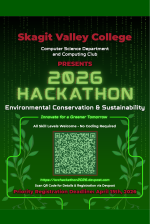 Have an idea for a more sustainable future? Join the Hackathon! No coding experience required. Must be a high school or college student. Visit SVCHackathon2026.devpost.com Have an idea for a more sustainable future? Join the Hackathon! No coding experience required. Must be a high school or college student. Visit SVCHackathon2026.devpost.com
Updated:
3/18/2026 10:28:46 AM
|
 SVC's annual Powwow is returning this May! SVC's annual Powwow is returning this May!
Updated:
3/10/2026 2:24:03 PM
|
 Come watch a live Court of Appeals oral argument session on the Whidbey Island Campus! Come watch a live Court of Appeals oral argument session on the Whidbey Island Campus!
Updated:
3/10/2026 1:57:59 PM
|
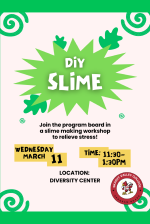 Come relieve some stress and make some SLIME! Drop by the Diversity Center on March 11 from 11:30-1:30 PM Come relieve some stress and make some SLIME! Drop by the Diversity Center on March 11 from 11:30-1:30 PM
Updated:
3/4/2026 10:30:04 AM
|
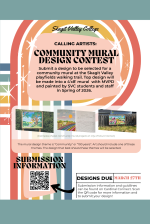 Submit a design to be selected for a community mural at the Skagit Valley playfields! Theme: "Community" or "100 years" to mark our 2026 Centennial Year. Scan QR for more info Submit a design to be selected for a community mural at the Skagit Valley playfields! Theme: "Community" or "100 years" to mark our 2026 Centennial Year. Scan QR for more info
Updated:
3/4/2026 10:09:45 AM
|
 Stop by the Diversity Center between 11 AM -1 PM for a free Red Bull Spritzer during finals week! Stop by the Diversity Center between 11 AM -1 PM for a free Red Bull Spritzer during finals week!
Updated:
3/4/2026 9:59:43 AM
|
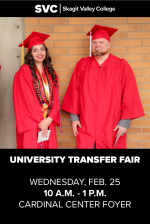 Come to the Transfer Fair this Wednesday! Meet college reps and ask questions! Come to the Transfer Fair this Wednesday! Meet college reps and ask questions!
Updated:
2/23/2026 4:50:32 PM
|
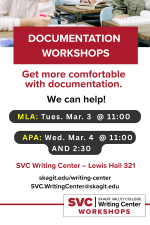 Come to the writing center in Lewis 321 to attend one of these workshops to get confident with documentation. Come to the writing center in Lewis 321 to attend one of these workshops to get confident with documentation.
Updated:
2/23/2026 3:52:13 PM
|
.thumb.png) Come join your fellow Cardinals for a free meal from Rooted Kitchen next Tuesday, Feb. 24 Come join your fellow Cardinals for a free meal from Rooted Kitchen next Tuesday, Feb. 24
Updated:
2/19/2026 4:13:37 PM
|
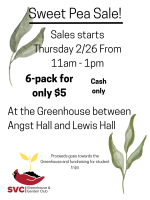 Come stock up on sweet pea starts at the greenhouse Thursday, February 26! 6-pack for $5, Cash only. Come stock up on sweet pea starts at the greenhouse Thursday, February 26! 6-pack for $5, Cash only.
Updated:
2/19/2026 4:10:16 PM
|
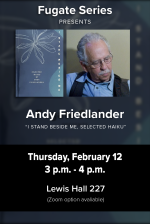 All are welcome to come listen to a haiku reading by Andy F. Snacks will be provided! All are welcome to come listen to a haiku reading by Andy F. Snacks will be provided!
Updated:
2/5/2026 3:18:35 PM
|
.thumb.png) Come to Lewis Hall for free hot cocoa next Tuesday! Come make friends, sip cocoa and celebrate Valentine's Day with CCF! Come to Lewis Hall for free hot cocoa next Tuesday! Come make friends, sip cocoa and celebrate Valentine's Day with CCF!
Updated:
2/4/2026 4:14:14 PM
|
|
Updated:
1/13/2026 12:29:28 PM
|
 International students AND American students, come share a meal, have conversations and make friends in Angst 129 on January 14th! International students AND American students, come share a meal, have conversations and make friends in Angst 129 on January 14th!
Updated:
1/9/2026 12:29:34 PM
|
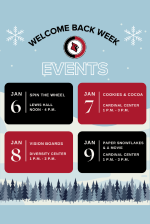 Welcome back, Cards! Don't miss these events to start the quarter off with fun festivities! Welcome back, Cards! Don't miss these events to start the quarter off with fun festivities!
Updated:
1/6/2026 3:02:34 PM
|
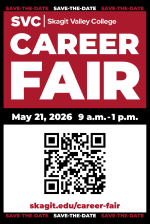 SAVE THE DATE! SVC's Annual Career Fair will be held May 21st, 2026 in Knutzen Cardinal Center. See you there! SAVE THE DATE! SVC's Annual Career Fair will be held May 21st, 2026 in Knutzen Cardinal Center. See you there!
Updated:
1/6/2026 2:52:46 PM
|
 Come by Cardinal Cafeteria this Thursday for a Pancake Party! (Sponsored by CCF) Come by Cardinal Cafeteria this Thursday for a Pancake Party! (Sponsored by CCF)
Updated:
1/6/2026 11:56:17 AM
|
 Follow us for news, events, and alerts! Scan the QR to find our socials!
Instagram @skagitvalleycollege,
Twitter @svccollege,
FB skagitvalleycollege. Follow us for news, events, and alerts! Scan the QR to find our socials!
Instagram @skagitvalleycollege,
Twitter @svccollege,
FB skagitvalleycollege.
Updated:
12/30/2025 4:02:00 PM
|
 Find out what's happening on campus! Visit skagit.edu/event-calendar Find out what's happening on campus! Visit skagit.edu/event-calendar
Updated:
12/30/2025 3:45:29 PM
|
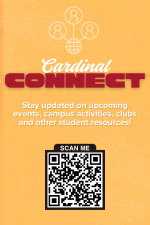 Join the Cardinal Community to stay informed on upcoming events, activities, and to learn about SVC's Clubs. Scan to check out the Cardinal Connect website & download the app! Join the Cardinal Community to stay informed on upcoming events, activities, and to learn about SVC's Clubs. Scan to check out the Cardinal Connect website & download the app!
Updated:
12/30/2025 3:21:24 PM
|
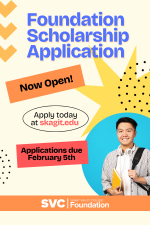 The Foundation Scholarship Application is now open to students! All current and future students are invited to apply by Feb. 5th, 2026. Visit Skagit.edu to apply. The Foundation Scholarship Application is now open to students! All current and future students are invited to apply by Feb. 5th, 2026. Visit Skagit.edu to apply.
Updated:
11/25/2025 2:39:36 PM
|
 The Writing Center is hiring Writing Consultants! See our website for qualifications and to apply. SVC Students helping SVC Students! Scan the QR code to learn more. The Writing Center is hiring Writing Consultants! See our website for qualifications and to apply. SVC Students helping SVC Students! Scan the QR code to learn more.
Updated:
10/24/2025 10:33:56 AM
|
 Join us for the University Transfer Fair at the Knutzen Cardinal Center on Wed., April 16 from 10 a.m.-1 p.m.! Connect with different universities and explore various pathways for your future. Join us for the University Transfer Fair at the Knutzen Cardinal Center on Wed., April 16 from 10 a.m.-1 p.m.! Connect with different universities and explore various pathways for your future.
Updated:
4/8/2025 6:20:23 PM
|
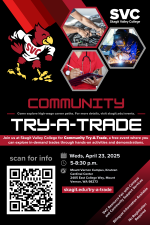 Don't miss the Community Try-A-Trade event at SVC on April 23rd at the Knutzen Cardinal Center. This is a free event where anyone can explore in-demand trades through hands on activities. Visit skagit.edu/try-a-trade for more. Don't miss the Community Try-A-Trade event at SVC on April 23rd at the Knutzen Cardinal Center. This is a free event where anyone can explore in-demand trades through hands on activities. Visit skagit.edu/try-a-trade for more.
Updated:
4/4/2025 5:00:31 PM
|
 Join us on Earth Day for the Clean Energy and Sustainaility Fair at the Knutzen Cardinal Center! On April 22nd from 10 - 3 pm, you can learn about careers in clean energy, environmental advocacy and more! Join us on Earth Day for the Clean Energy and Sustainaility Fair at the Knutzen Cardinal Center! On April 22nd from 10 - 3 pm, you can learn about careers in clean energy, environmental advocacy and more!
Updated:
4/4/2025 1:25:40 PM
|
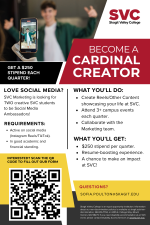 Love social media? SVC Marketing is looking for TWO SVC students to be Social Media Ambassadors! You'll get $250 a quarter, a resume boosting experience, and a chance to make a creative impact at SVC!
Fill out our interest form today by scanning the QR code on the graphic! Love social media? SVC Marketing is looking for TWO SVC students to be Social Media Ambassadors! You'll get $250 a quarter, a resume boosting experience, and a chance to make a creative impact at SVC!
Fill out our interest form today by scanning the QR code on the graphic!
Updated:
4/4/2025 1:20:38 PM
|
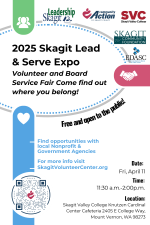 Don't miss the Skagit Lead and Serve Expo on April 11th in the Knutzen Cardinal Center from 11:30 am - 2 pm! Learn about ways to get involved in the community. This event is free and open to the public. Don't miss the Skagit Lead and Serve Expo on April 11th in the Knutzen Cardinal Center from 11:30 am - 2 pm! Learn about ways to get involved in the community. This event is free and open to the public.
Updated:
4/2/2025 3:32:07 PM
|
 SVC Presents the Spring Poetry Series! Don't miss poetry readings from Ricardo Ruiz and Lorraine Healy. For more information, contact libby.sullivan@skagit.edu or gail.bruce@skagit.edu. SVC Presents the Spring Poetry Series! Don't miss poetry readings from Ricardo Ruiz and Lorraine Healy. For more information, contact libby.sullivan@skagit.edu or gail.bruce@skagit.edu.
Updated:
3/19/2025 11:25:22 AM
|
.thumb.png) Submit your graduation application by Thursday, April 24, 2025 to ensure your name is printed in the Commencement Ceremony Program! Visit grad.skagit.edu today to apply. Submit your graduation application by Thursday, April 24, 2025 to ensure your name is printed in the Commencement Ceremony Program! Visit grad.skagit.edu today to apply.
Updated:
3/6/2025 2:34:44 PM
|
-2.thumb.png) It's time to register for spring quarter! Classes start April 8th. Enroll today by visiting skagit.edu/getting-started/ It's time to register for spring quarter! Classes start April 8th. Enroll today by visiting skagit.edu/getting-started/
Updated:
3/6/2025 2:29:11 PM
|
 Don't miss Cinderella at McIntyre Hall from February 21 - March 2! Scan the QR Code to get tickets today. Don't miss Cinderella at McIntyre Hall from February 21 - March 2! Scan the QR Code to get tickets today.
Updated:
2/5/2025 9:57:31 AM
|
 Join us for two impactful shows:
Fly For Freedom:
Explore the untold stories of Black women aviators during WWII and their fight for democracy on multiple fronts.
The Right To Dream:
Step into the journey of a young civil rights activist navigating the struggles for Black equality and voting rights in the 1960s South.
RSVP:
Feb 13th, 9am-1pm
LIMITED SPOTS | Email: BSU@SKAGIT.EDU TO RESERVE Join us for two impactful shows:
Fly For Freedom:
Explore the untold stories of Black women aviators during WWII and their fight for democracy on multiple fronts.
The Right To Dream:
Step into the journey of a young civil rights activist navigating the struggles for Black equality and voting rights in the 1960s South.
RSVP:
Feb 13th, 9am-1pm
LIMITED SPOTS | Email: BSU@SKAGIT.EDU TO RESERVE
Updated:
1/31/2025 3:34:42 PM
|
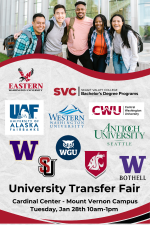 Don't miss the Universtity Transfer Fair at the Cardinal Center on Tues, Jan 28th from 10am-1pm! Connect with different colleges and explore different pathways for your future. Don't miss the Universtity Transfer Fair at the Cardinal Center on Tues, Jan 28th from 10am-1pm! Connect with different colleges and explore different pathways for your future.
Updated:
1/15/2025 11:20:31 AM
|
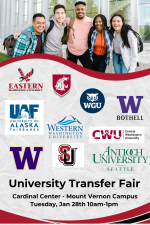 Mark Your Calendar for the University Transfer Fair!
Date: January 28th
Time: 10:00 AM - 1:00 PM
Location: Cardinal Center
Explore your future by connecting with universities and discovering transfer opportunities. Don’t miss this exciting event! Mark Your Calendar for the University Transfer Fair!
Date: January 28th
Time: 10:00 AM - 1:00 PM
Location: Cardinal Center
Explore your future by connecting with universities and discovering transfer opportunities. Don’t miss this exciting event!
Updated:
1/15/2025 10:34:18 AM
|
 Four year degree opportunities are here! SVC offers bachelor's degree programs in:
• Advanced Manufacturing and
Design
• Computer Science
• Environmental Conservation
• Healthcare Management
• Management
Visit skagit.edu/bachelors to learn more today! Four year degree opportunities are here! SVC offers bachelor's degree programs in:
• Advanced Manufacturing and
Design
• Computer Science
• Environmental Conservation
• Healthcare Management
• Management
Visit skagit.edu/bachelors to learn more today!
Updated:
12/23/2024 3:39:57 PM
|
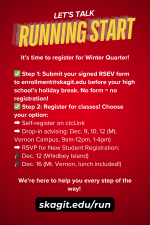 Interested in Running Start? It's time to enroll for Winter Quarter! Submit your RSEV to enrollment@skagit.edu and register for classes through ctcLink, attending drop-in advising, or going to New Student Orientation. Visit skagit.edu/run today for more! Interested in Running Start? It's time to enroll for Winter Quarter! Submit your RSEV to enrollment@skagit.edu and register for classes through ctcLink, attending drop-in advising, or going to New Student Orientation. Visit skagit.edu/run today for more!
Updated:
12/11/2024 1:37:55 PM
|
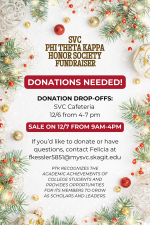 Donate to the PTK Rummage Sale in the SVC Cafeteria on 12/6 from 4-7 pm. Make sure you come to the sale on 12/7 from 9am - 4pm in the cafeteria as well! Questions? Contact fkessler5851@mysvc.skagit.edu Donate to the PTK Rummage Sale in the SVC Cafeteria on 12/6 from 4-7 pm. Make sure you come to the sale on 12/7 from 9am - 4pm in the cafeteria as well! Questions? Contact fkessler5851@mysvc.skagit.edu
Updated:
12/6/2024 10:49:55 AM
|
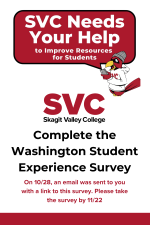 Students! Don't forget to complete your Washington Student Experience Survey that was sent to your email on 10/28. We need your help to improve student resources! Complete it by 11/22 to make sure your voice is heard. Students! Don't forget to complete your Washington Student Experience Survey that was sent to your email on 10/28. We need your help to improve student resources! Complete it by 11/22 to make sure your voice is heard.
Updated:
11/5/2024 11:36:33 AM
|
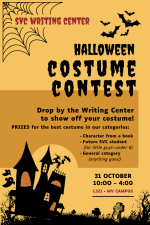 Drop by the writing center to show off your costume! October 31st, 10 am - 4 pm. Prizes for the best costumes in our categories. Drop by the writing center to show off your costume! October 31st, 10 am - 4 pm. Prizes for the best costumes in our categories.
Updated:
10/28/2024 12:45:07 PM
|
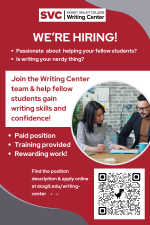 The SVC Writing Center is hiring! Join the Writing Center team and help fellow students gain writing skills and confidence. Apply online at skagit.edu/writing-center today. The SVC Writing Center is hiring! Join the Writing Center team and help fellow students gain writing skills and confidence. Apply online at skagit.edu/writing-center today.
Updated:
10/23/2024 4:21:37 PM
|
|
Don't miss Jazz Underground, presented by KSVR Radio at Tarro Theater on October 12! The show starts at 1pm. To learn more, visit ksvr.org or scan the QR code today!
Updated:
9/27/2024 10:05:46 AM
|
.thumb.png) Get ready to kick off the Fall Quarter! ?? Join us for 'Welcome Back Week' starting Monday 9/23, packed with exciting events you won't want to miss. See you there! Get ready to kick off the Fall Quarter! ?? Join us for 'Welcome Back Week' starting Monday 9/23, packed with exciting events you won't want to miss. See you there!
Updated:
9/19/2024 12:28:24 PM
|
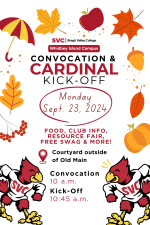 On behalf of the College and in partnership with the President, and Department of Student Life, we are delighted to welcome you to an enriching and engaging year. The program will feature music and drumming performances, as well as welcoming remarks from SVC College President, Dr. Christopher Villa and VP of Student Services, Dr. Claire Peinado.
After Convocation, stick around for Cardinal Kickoff at 10:45 which includes free food, swag, and a Clubs and Resources Fair.
Both Convocation and Cardinal Kickoff will take place in the Campus Courtyard! On behalf of the College and in partnership with the President, and Department of Student Life, we are delighted to welcome you to an enriching and engaging year. The program will feature music and drumming performances, as well as welcoming remarks from SVC College President, Dr. Christopher Villa and VP of Student Services, Dr. Claire Peinado.
After Convocation, stick around for Cardinal Kickoff at 10:45 which includes free food, swag, and a Clubs and Resources Fair.
Both Convocation and Cardinal Kickoff will take place in the Campus Courtyard!
Updated:
9/17/2024 1:46:21 PM
|
|
On behalf of the College and in partnership with the President, and Department of Student Life, we are delighted to welcome you to an enriching and engaging year. The program will feature music and drumming performances, as well as welcoming remarks from SVC College President, Dr. Christopher Villa and VP of Student Services, Dr. Claire Peinado.
Convocation will take place on the Lewis/Hodson Hall Lawn.
After convocation, walk over to Tollefson Plaza for Cardinal Kickoff at 3:15pm. The kickoff includes a Clubs and Resource Fair, Food, and Swag for students!
Updated:
9/17/2024 1:44:44 PM
|
|
Updated:
6/12/2024 11:28:57 AM
|
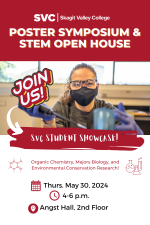 Don't miss the Poster symposium & STEM open house on May 30th from 4-6 pm in Angst Hall on the 2nd floor! SVC students will showcase their Organic Chemistry, Majors Biology, and Environmental Conservation Research! Don't miss the Poster symposium & STEM open house on May 30th from 4-6 pm in Angst Hall on the 2nd floor! SVC students will showcase their Organic Chemistry, Majors Biology, and Environmental Conservation Research!
Updated:
5/28/2024 2:40:33 PM
|
 Drama Club needs 3 actors for "A Commercial Jingle for Regina Comet." Show us what you got! Contact jared.lankford@skagit.edu for more info. Auditions in Tarro Theater. Drama Club needs 3 actors for "A Commercial Jingle for Regina Comet." Show us what you got! Contact jared.lankford@skagit.edu for more info. Auditions in Tarro Theater.
Updated:
5/23/2024 2:22:22 PM
|
.thumb.png) Welcome to the 2024 Career and Internship Fair! Thank you to our amazing sponsors who helped make this event happen. Welcome to the 2024 Career and Internship Fair! Thank you to our amazing sponsors who helped make this event happen.
Updated:
5/23/2024 10:01:39 AM
|
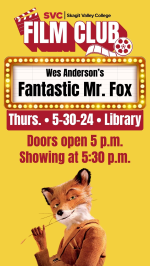 The SVC Film Club invites you to a showing of Wes Anderson's Fantastic Mr. Fox. Free! At the Library. Doors open at 5 p.m. Showing at 5:30. On Thursday, May 30, 2024. The SVC Film Club invites you to a showing of Wes Anderson's Fantastic Mr. Fox. Free! At the Library. Doors open at 5 p.m. Showing at 5:30. On Thursday, May 30, 2024.
Updated:
5/21/2024 12:30:34 PM
|
.thumb.jpg) Apply to graduate at grad.skagit.edu today! To have your name in the program, you need to apply by April 25th. Don't wait, complete your application today. For additional info, visit skagit.edu/commencement. Apply to graduate at grad.skagit.edu today! To have your name in the program, you need to apply by April 25th. Don't wait, complete your application today. For additional info, visit skagit.edu/commencement.
Updated:
4/23/2024 11:06:21 AM
|
.thumb.jpg) Apply for FAFSA today to secure summer and fall quarter funding! For more information and financial aid workshops, visit Skagit.edu/FAFSA. Don't wait! Apply for FAFSA today to secure summer and fall quarter funding! For more information and financial aid workshops, visit Skagit.edu/FAFSA. Don't wait!
Updated:
4/15/2024 11:27:25 AM
|
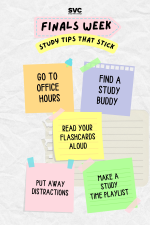 Good luck on finals, Cardinals! You've got this. Good luck on finals, Cardinals! You've got this.
Updated:
6/12/2023 10:38:13 AM
|
 June is Pride Month! The Library's LGBTQ+ research guide is an amazing resource to read and share as you celebrate. Scan the QR code to view the guide today! June is Pride Month! The Library's LGBTQ+ research guide is an amazing resource to read and share as you celebrate. Scan the QR code to view the guide today!
Updated:
6/5/2023 11:54:03 AM
|
 Come to Experience India 2023 at the Ferndale Events Center on June 16th! Doors open at 5pm. Scan the QR code to get your free tickets today and to view more information.
This scholarship fundraiser event will feature various performances and an Indian buffet! Open to all. Come to Experience India 2023 at the Ferndale Events Center on June 16th! Doors open at 5pm. Scan the QR code to get your free tickets today and to view more information.
This scholarship fundraiser event will feature various performances and an Indian buffet! Open to all.
Updated:
5/24/2023 3:05:51 PM
|
 SVC's outdoor club is taking over Lake Whatcom on May 27th @ 11 pm! Transportation, food, and lake rentals will all be provided for free - all you have to do is sign up!
Contact Maddy Carlson by email at mcarlson4826@mysvc.skagit.edu or visit the Outdoor Club's Canvas site today to get signed up. SVC's outdoor club is taking over Lake Whatcom on May 27th @ 11 pm! Transportation, food, and lake rentals will all be provided for free - all you have to do is sign up!
Contact Maddy Carlson by email at mcarlson4826@mysvc.skagit.edu or visit the Outdoor Club's Canvas site today to get signed up.
Updated:
5/24/2023 2:15:58 PM
|
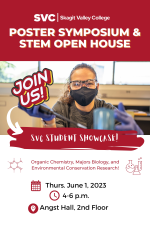 Make sure you stop by this year's Poster Symposium & STEM Open House on June 1st in Angst Hall! STEM Students will be showcasing their research projects to students, staff, & the public. Doors open at 4pm - see you there! Make sure you stop by this year's Poster Symposium & STEM Open House on June 1st in Angst Hall! STEM Students will be showcasing their research projects to students, staff, & the public. Doors open at 4pm - see you there!
Updated:
5/10/2023 10:47:40 AM
|
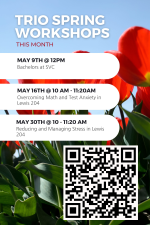 Trio is hosting 3 open workshops in May that are available to all students. To join, scan the QR code provided to access the virtual workshops and receive important information. Food will be provided during each session, so don't miss out on the chance to learn and engage with others. Trio is hosting 3 open workshops in May that are available to all students. To join, scan the QR code provided to access the virtual workshops and receive important information. Food will be provided during each session, so don't miss out on the chance to learn and engage with others.
Updated:
5/4/2023 2:37:49 PM
|
 Get ready for Movie Tuesdays at Whidbey Island Campus! Visit Oak Hall 306 on May 2nd & May 16th for movie showings from 12-2pm. Get ready for Movie Tuesdays at Whidbey Island Campus! Visit Oak Hall 306 on May 2nd & May 16th for movie showings from 12-2pm.
Updated:
5/1/2023 10:35:49 AM
|
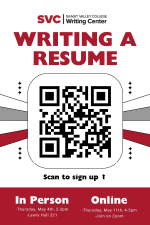 Looking to up your resume game? ?? Join us on campus on May 4th from 2-3pm or online on May 11th from 4-5pm for a resume writing workshop! ?? Learn about different resume styles and get help with formatting to make your resume stand out to potential employers. Sign up using the QR code or by visiting skagit.mywconline.com Looking to up your resume game? ?? Join us on campus on May 4th from 2-3pm or online on May 11th from 4-5pm for a resume writing workshop! ?? Learn about different resume styles and get help with formatting to make your resume stand out to potential employers. Sign up using the QR code or by visiting skagit.mywconline.com
Updated:
5/1/2023 10:19:17 AM
|
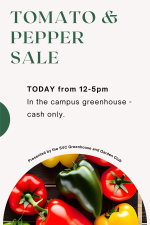 Head over to the campus greenhouse today for a tomato and pepper sale! Cash accepted only. Presented by the Greenhouse and Garden Club. Head over to the campus greenhouse today for a tomato and pepper sale! Cash accepted only. Presented by the Greenhouse and Garden Club.
Updated:
4/27/2023 11:33:51 AM
|
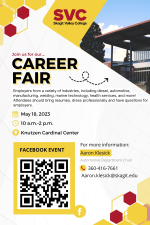 Skagit Valley College is hosting its first annual Career Fair, which is free and open to the public! Attendees should bring resumes, dress professionally and have questions for employers.
There will be employers from a variety of industries, including diesel, automotive, manufacturing, welding, marine technology, health services, and more! Skagit Valley College is hosting its first annual Career Fair, which is free and open to the public! Attendees should bring resumes, dress professionally and have questions for employers.
There will be employers from a variety of industries, including diesel, automotive, manufacturing, welding, marine technology, health services, and more!
Updated:
4/21/2023 10:46:05 AM
|
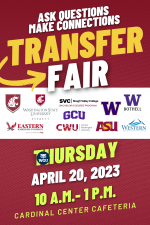 Ask questions! Make connections! With Universities and SVC's Bachelor's Program. Learn more about transferring your credits. Join us Thursday, April 20, 2023, 10 a.m.-1 p.m. at the Cardinal Center Cafeteria! Ask questions! Make connections! With Universities and SVC's Bachelor's Program. Learn more about transferring your credits. Join us Thursday, April 20, 2023, 10 a.m.-1 p.m. at the Cardinal Center Cafeteria!
Updated:
4/13/2023 5:08:03 PM
|
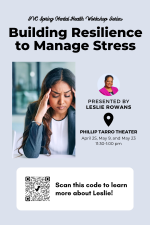 Don't miss these SVC Spring Mental Health Workshops on April 25th, May 9th, and May 23rd in the Phillip Tarro Theater! Leslie Rowans will be leading the workshops and talking about building resilience to manage stress. Don't miss these SVC Spring Mental Health Workshops on April 25th, May 9th, and May 23rd in the Phillip Tarro Theater! Leslie Rowans will be leading the workshops and talking about building resilience to manage stress.
Updated:
4/13/2023 1:41:23 PM
|
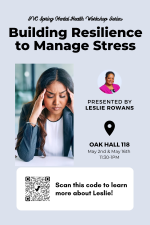 Don't miss these SVC WIC spring mental health workshops on May 2nd & 16th in Oak Hall 118! Leslie Rowans will be leading the workshops and talking about building resilience to manage stress. Don't miss these SVC WIC spring mental health workshops on May 2nd & 16th in Oak Hall 118! Leslie Rowans will be leading the workshops and talking about building resilience to manage stress.
Updated:
4/13/2023 1:33:31 PM
|
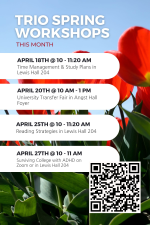 Trio is hosting four workshops in April that are available to all students!
For more information and links to online sessions, scan the QR code. Food will be provided during each session, so don't miss out! Trio is hosting four workshops in April that are available to all students!
For more information and links to online sessions, scan the QR code. Food will be provided during each session, so don't miss out!
Updated:
4/10/2023 2:32:51 PM
|
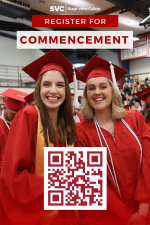 Attention spring grads!
Commencement is right around the corner, which means it's time to apply to graduate.
Register for commencement by April 25th to ensure your name is printed in the program. Visit skagit.edu/commencement to sign up today. Attention spring grads!
Commencement is right around the corner, which means it's time to apply to graduate.
Register for commencement by April 25th to ensure your name is printed in the program. Visit skagit.edu/commencement to sign up today.
Updated:
3/27/2023 1:00:35 PM
|
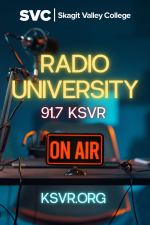 Could you be Skagit Valley's next radio personality? Come share your music and talent on the airwaves. You must own the music you play. "Radio University" is between 2-4 p.m. Learn more at KSVR.org or contact joseph@ksvr.org. Could you be Skagit Valley's next radio personality? Come share your music and talent on the airwaves. You must own the music you play. "Radio University" is between 2-4 p.m. Learn more at KSVR.org or contact joseph@ksvr.org.
Updated:
3/9/2023 4:11:28 PM
|
 Your Path to a Bachelor Degree is Closer than You Think!Did you know, our bachelor of applied
science degrees can build upon your two-year professional/technical
associate’s degree? Our degrees are designed to help you earn a
bachelor’s degree without having to start from the beginning at a
four-year university. In our programs, you will only need to complete
two more years of upper-level coursework to complete your degree. To learn more, sign up for a program briefing skagit.edu/bas.
Updated:
3/6/2023 3:32:40 PM
|
 Don’t have Wi-Fi at
home? We can help get you connected. The library has a great selection
of free or low-cost internet services for students. Visit: www.skagit.edu/wifi There are internet providers that offer discounts to students. If you have any questions, please reach out. We are here to help!
Updated:
2/13/2023 4:04:00 PM
|
 Skagit Valley College’s music department will host open auditions for
the spring production of “Something Rotten!” on Jan. 18-19 between 6-9
p.m. in the Tarro Theatre on the Mount Vernon campus. Fore more info visit: skagit.edu/auditions. Skagit Valley College’s music department will host open auditions for
the spring production of “Something Rotten!” on Jan. 18-19 between 6-9
p.m. in the Tarro Theatre on the Mount Vernon campus. Fore more info visit: skagit.edu/auditions.
Updated:
1/5/2023 3:44:29 PM
|
 Sign up now! Meet with an advisor and get help registering for winter classes. skagit.edu/admissions/cardinal-takeoff Sign up now! Meet with an advisor and get help registering for winter classes. skagit.edu/admissions/cardinal-takeoff
Updated:
11/14/2022 7:48:21 PM
|
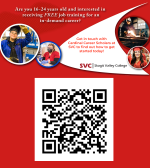 Are you 16-24 years old and interested in receiving FREE job training
for an in-demand career? To get started call (360) 416-7973 or visit the
Workforce Grants office on campus in the Lewis Hall building. Are you 16-24 years old and interested in receiving FREE job training
for an in-demand career? To get started call (360) 416-7973 or visit the
Workforce Grants office on campus in the Lewis Hall building.
Updated:
9/26/2022 9:27:59 AM
|
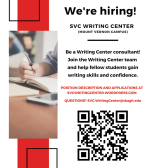 SVC Writing Center is hiring consultants to help fellow students gain writing skills and confidence! Get more info and apply at svcwritingcenter.wordpress.com Join the team! SVC Writing Center is hiring consultants to help fellow students gain writing skills and confidence! Get more info and apply at svcwritingcenter.wordpress.com Join the team!
Updated:
9/26/2022 9:05:04 AM
|